
A Victory in Silwan
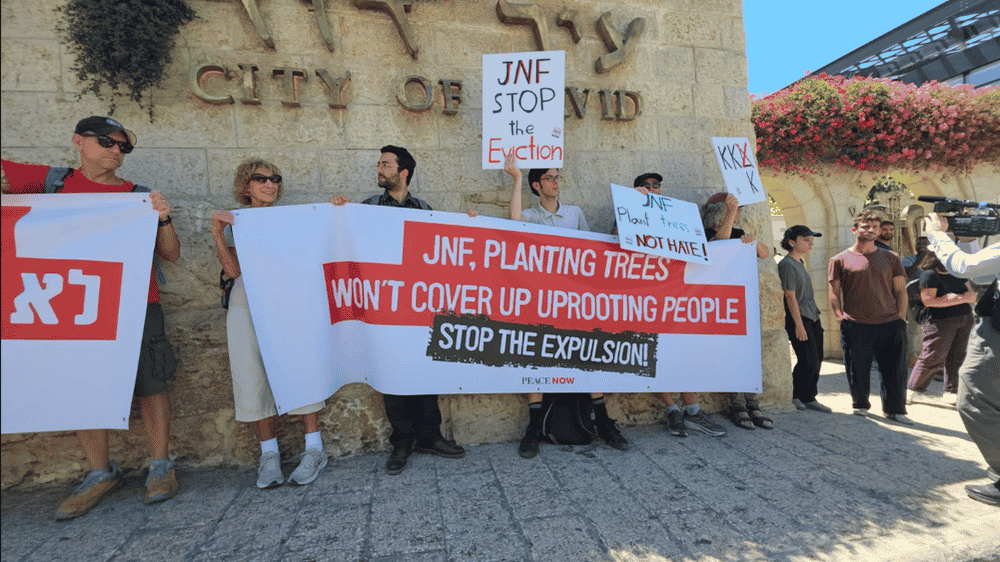
The protest led by Peace Now and Ir Amim against the eviction of the Shaludi family from Silwan.
Noam Shelef — June 29, 2026
Views and positions expressed here are those of the writer, and do not necessarily represent NJN's views and policy positions.
Last week, a pressure campaign spearheaded by Peace Now delivered a victory. The Shaludi family of Silwan is going to get to stay in their home. Abed Shaludi, who was born there fifty-five years ago and raised four children in the shadow of an olive tree he'd known since childhood, had been ordered to vacate by June 24th. The Jewish National Fund – operating through a subsidiary – was evicting him from a home his family has lived in since before Israel ruled the territory.
Many of us were raised with an image of JNF as a “consensus” organization. Founded more than a century ago to purchase real estate that allowed Jews to build cities and towns in the land of Israel, we had been told that it was transformed after the establishment of the state. The modern JNF – at least according to its own marketing materials – planted forests, built water infrastructure, and managed public parks.
That image shattered for me nearly thirty years ago, when I worked for an Israeli nonprofit that engaged in legal advocacy to help redress discrimination that Palestinian residents of Jerusalem face. I remember learning about a scheme – uncovered in an official government report – by which settler leaders had turned the JNF into a tool to steal Palestinian property rights and transfer those rights to the settlers.
To make things even more destructive, the JNF-settler scheme was being activated in one of the most sensitive areas in Jerusalem: Silwan – a Palestinian neighborhood just south of the Old City walls.
To do this, they exploited Israel's 1950 Absentees' Property Law. The law was enacted after Israel's War of Independence to transfer control of property whose Palestinian owners had fled or been expelled. Those properties were placed under the control of the Custodian of Absentees' Property, which, in these cases, transferred them to the JNF. The JNF then transferred them to settler organizations.
One absurdity in the law is that it defines "absentee" to include anyone who was a resident of an enemy territory. And because the law is from 1950, “enemy” territory includes the West Bank – although it is under Israeli military occupation. A family can be dispossessed based on the idea that the owner is “absentee” even if that owner lives on land that Israel controls, a few kilometers away.
The standard for proving that a landowner is “absentee” is remarkably thin. In one case I remember vividly, a lawyer who represented both the JNF subsidiary and settler groups had filed an affidavit – ostensibly signed by a Palestinian taxi driver – claiming that the family whose property was at stake lived in Jordan. My boss at the time represented this family. They lived in the United States; not in Jordan, and not in an enemy state by any measure.
The affidavit was accepted without verification. The process of transferring this family’s property had begun. Only after the taxi driver failed to appear in court on multiple occasions, and after the family flew in from the US to sit in the courtroom themselves, did the judge finally throw out the affidavit. That's what it took to refute a single piece of paper.
This is exactly what happened to the Shaludi family. The Shaludis have long rented the property from its owner, Haj Musa Sumarin. But the Custodian of Absentees' Property declared him to be an absentee based on an affidavit without, as a judge later found, so much as checking the population registry. Sumarin, it turned out, had lived in Jerusalem until his death in 1983. He was never an absentee.
But that court decision was not the end. The JNF's subsidiary prevailed on appeal by arguing that Sumarin's children – not Sumarin himself – were absentee owners. Ownership was transferred, the JNF gained control of the property, and it could legally evict the Shaludis if it wanted to.
The abuse of the Israeli legal system – the stacking of the deck against Palestinians – should be shocking. The JNF’s involvement in land theft should be an outrage. But today, very few of us are truly surprised. We know that the settler movement, motivated by a Jewish supremacist ideology, has figured out how to pull every lever to reshape Israel to fit its agenda. The JNF’s role in the abuse of the Absentee Property Law is but one example.
That’s what makes last week’s win so remarkable.
Given all that the settlers have done to corrupt the system, we had every reason to believe that the settlers would win again. The Shaludis had exhausted their legal options. The courts had ruled that the JNF could evict them. And the JNF’s subsidiary has already evicted dozens of Palestinian families in Silwan to turn the homes over to settler groups.
Why would this time turn out differently? Because our colleagues at Peace Now refused to accept that the legal battle was the end of the story. They picked up the mantle. They made sure that the story made it to the press. And together with Ir Amim, they protested outside of the board meeting of the JNF subsidiary at the exact moment its leadership was meeting to discuss the eviction.
The good news arrived while Peace Now’s leaders were on the bus home after the protest: The Shaludi family was not being evicted. Instead, the JNF responded to the pressure campaign. They decided that they would not enforce the eviction order but would instead negotiate with the family about the terms under which they can stay.
This is what a victory looks like. To me, it’s evidence that the settlers haven’t won yet, not over the Shaludi family – nor over the question of Israel’s future. It gives me reason to hope.
Noam Shelef is New Jewish Narrative’s Vice President of Communications. His career began nearly 30 years ago as an intern for Americans for Peace Now. Since then, Noam has worked to support progressive change in Israel as a lobbyist, an organizer, and a communications leader.
