
Norms of Occupation
Hagit Ofran — April 13, 2026
Views and positions expressed here are those of the writer, and do not necessarily represent NJN's views and policy positions.
The recent encounter between “Netzah Yehuda” reservists and a CNN team that led to the battalion’s suspension has drawn renewed attention to a reality that many prefer not to see.
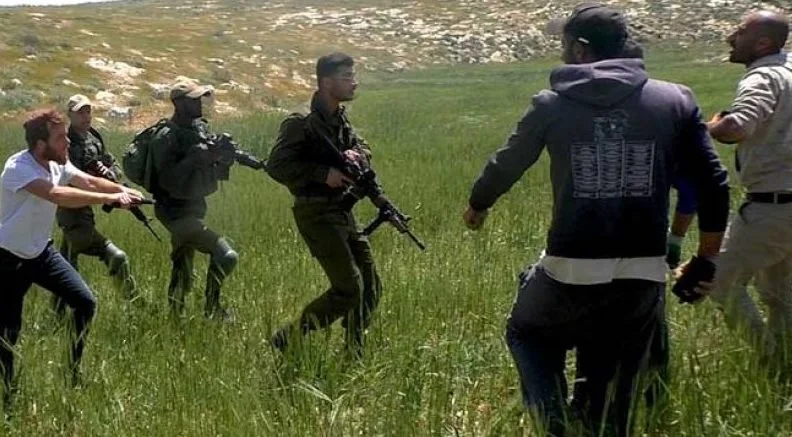
For me, this was not a surprise. It brought back a meeting I had several years ago with soldiers from this same unit on the lands of Burqa, near the illegal outpost of Ramat Migron.
At the time, I accompanied Palestinian landowners who were trying to access their land—land that had been taken over by settlers. When we arrived, soldiers quickly came and expelled the Palestinians. That, in itself, was not unusual. What was striking was what they said as they did it—what they thought of me, and what they believed should be done to me.
“You’re a piece of trash,” they said.
“You’re a traitor… We have a death penalty for traitors.”
“That’s what I think of you, and that’s what I would do to you.”
Here’s video footage from that incident:
But the truth is more troubling than any single incident.
Other soldiers would likely have done the same. Perhaps they would not have spoken in the same way. Perhaps they would not have openly said that I should be killed. But, make no mistake, the outcome would have been identical: The Palestinians would have been removed from their land. The settlers’ violent land grab would have been enabled.
This is not an aberration. It has, sadly, become the norm in the West Bank
The same applies to the encounter with CNN. Any other unit would likely have acted similarly: removing the Palestinians and the journalists, while shielding the settlers who were attacking them. These are the orders soldiers are given. The difference with some of the soldiers from Netzah Yehuda is not necessarily what they do, but that they say it out loud.
The latest incident with Netzah Yehuda drew international news headlines. Political pressure for action grew and the IDF made the unusual decision to retrain the entire unit. But what happened with Netzah Yehuda is not just a story about one battalion behaving badly. It is a window into a system that has normalized dispossession and made it routine. When soldiers are sent to enforce a reality in which one group’s rights are systematically denied in favor of another’s, the outcome is predictable—no matter who is wearing the uniform.
Focusing on the most extreme voices or the most offensive statements risks missing the deeper truth. The problem is not only what some soldiers say. It is what they are asked to do, day after day, and what that reveals about the policies guiding them.
If we want to prevent the next incident—whether caught on camera or not—we cannot limit ourselves to condemning individual units or disciplining a handful of soldiers. We have to confront the system that produces these outcomes, the rules that make them inevitable, and the broader reality that allows them to continue largely unchecked.
Until that changes, there will be more encounters like this one. The names will be different. The footage may or may not surface. But the story will remain the same. This is not a reality that we can afford to condone.
Hagit Ofran is Israel’s leading expert on settlements and the Israeli government’s policies in the Occupied Territories. As co-director of Peace Now’s Settlement Watch program, Hagit has spent decades documenting settlement expansion and tracking the legal and political mechanisms driving de facto annexation.
Photo by Basel al-’Adrah, CC BY 4.0, via Wikimedia Commons
