
This Is the Worst Wave of Settler Violence Yet: Stopping It Will Take All of Us
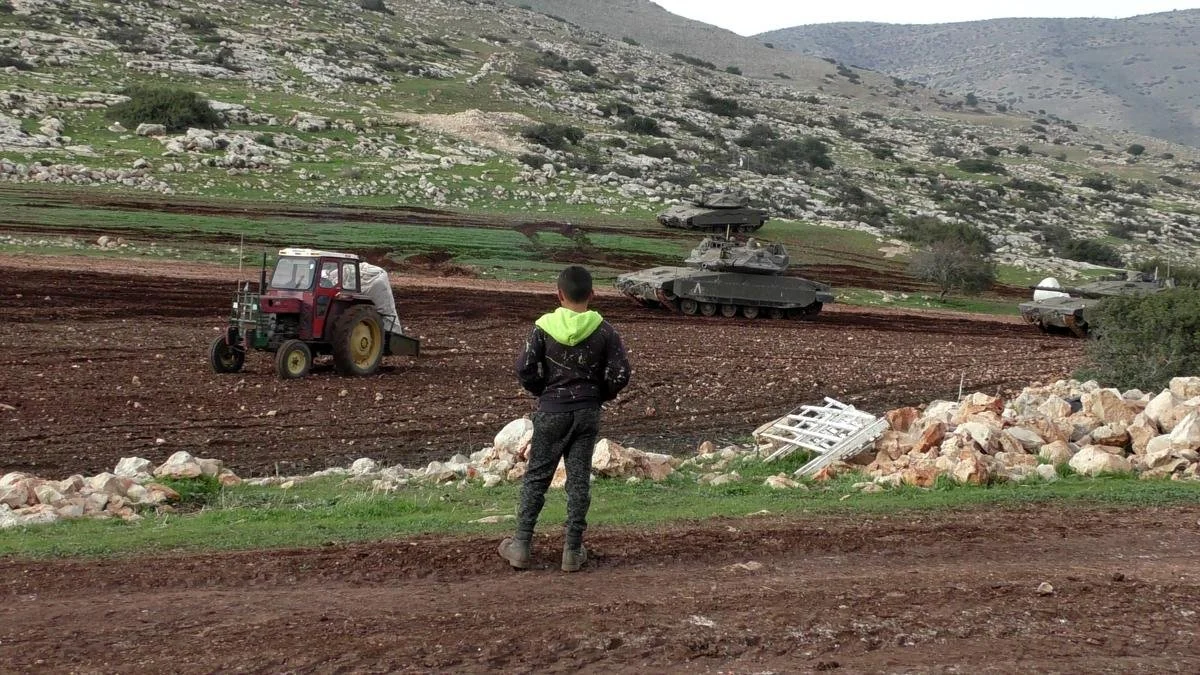
Israeli tanks train in the fields of the West Bank village of Khirbet Ibziq, damaging barley crops.
Becca Strober — March 23, 2026
Views and positions expressed here are those of the writer, and do not necessarily represent NJN's views and policy positions.
Q: What's happening right now in the West Bank?
A: Under the cover of the war with Iran, we're seeing the worst wave of settler violence we've ever witnessed in the West Bank. Multiple Palestinians have been murdered. Multiple Israeli activists have been beaten to the point they need hospitalization. Even international solidarity activists — including Jewish Americans — have had their visas revoked for engaging in solidarity work.
One case that captures the current reality: A settler hit a five-year-old Palestinian girl with his car. When the police arrived, instead of arresting the settler, they arrested the American Jewish solidarity activist who had reported the incident. The girl was hospitalized — thankfully she's recovering — and the activist was deported. The settler who hit the girl has not been detained or questioned and is currently free.
This is the logic operating on the ground right now. Since October 7, 2023, we've seen a massive escalation in the ethnic cleansing of Palestinian villages in Area C — the part of the West Bank under full Israeli military control, where all the settlements are. Dozens of villages have been forcibly transferred since then. Communities that I and many others spent years working in simply don't exist anymore. People were driven out by relentless settler violence with no protection from the army or police.
This didn't come from nowhere. We saw a spike during COVID when internationals left. Sukkot 2021 brought a pogrom in Mufaqara, where settlers blocked an ambulance carrying an injured child and the army secured the settlers. In 2022, settler militias completely blockaded Nablus — and then Israeli soldiers came and enforced that civilian blockade themselves. Each of these moments set a new floor for what's considered normal. What we're living through now is the result of that accumulation.
Q: How has settler violence changed over the years and what’s the role of law enforcement?
A: Twenty or fifteen years ago, state-backed settler violence was happening as a measure to take over land in the West Bank, especially Area C, which is under full Israeli control — but it looked different. There would be a group of settlers, maybe one with a gun, others with rocks or metal pipes, pressuring Palestinians off their land mainly through intimidation and stone throwing. The army largely looked the other way, the police rarely made arrests of settlers, and some of that land would eventually end up in settler hands.
Over the years, the roles and structures have gradually changed. Today, there are armed militias — organized with dozens of members each and armed with rifles. The number of rifles in the hands of settlers, including those who are documented having committed violent crimes, increased sharply around 2020-2021 (and then exploded after October 7, 2023), accelerated by Ben Gvir handing out thousands of weapons as national security minister.
An additional shift is the effective merger between settlers and the military. When I served in the army between 2008 and 2010, soldiers generally weren't told to stop settler violence — but they mostly stood around idly. Now we're seeing active participation: Soldiers firing stun grenades alongside settlers attacking villages, military units enforcing blockades that settler militias initiated. Soldiers opening fire on Palestinians following settler-initiated pogroms.
The most tectonic shift is that after October 7, many settlers with histories of violence were enlisted into the army’s regional West Bank brigades, supposedly to guard their own settlements. In practice, the people who were terrorizing Palestinians before are now doing it in uniform. The distinction between settler militia and army has largely collapsed.
This trend began even before this current government came to office and is likely to continue until serious political pressure from other countries works to change it or until the ethnic cleansing of large swaths of the West Bank is basically complete.
Q: What's your role in all of this and how do we fight back?
A: One of the main things Israeli and international solidarity activists have been doing is protective presence — accompanying Palestinians to fields and grazing areas (though these have become less accessible since October 7th) and being with families in their communities to help prevent settler attacks, document incidents, and de-escalate the situation when incidents do happen. Activists have been doing this work for years, and thanks to sustained organizing, it has grown in participation, both among Israelis and internationally. The call from these Palestinian communities to come and stand in solidarity with them — to use whatever privilege we (as Israelis, or internationals) have to de-escalate — is louder than ever.
I have been an organizer in the field for 12 years, working to bring more and more people into this work. Today, I direct Achvat Amim, an organization that brings diaspora Jews to do movement-building work in Israel-Palestine. Protective Presence is one central element of that, alongside relationship-building and ensuring that people carry these realities back home with them after their time with us ends. I genuinely believe a lot of families are still in their homes and villages because of this Palestinian-Israeli-international joint work.
As the current situation makes clear, protective presence is badly needed. And to a large extent, it works — for years we've seen that villages where Israeli and international activists showed up consistently were less likely to be ethnically cleansed. But arguably, precisely because it works, it has become a target. Settlers, the army, and police have increasingly focused their efforts on harming solidarity activists directly, and we've seen a real and troubling uptick in that.
Q: People talk a lot about protective presence today. What's the strategy behind protective presence? What’s our role in the diaspora?
A: Protective presence is a solidarity tactic where activists physically show up alongside vulnerable communities to help slow displacement and de-escalate tensions in real time, while also supporting legal interventions and political advocacy. It was never designed to stop ethnic cleansing on its own — it's one piece of a larger puzzle, intended to buy time while pressure builds on the international community to act.
The tactic has real limitations — it doesn't work equally everywhere, it's becoming riskier, and in some places de-escalation is nearly impossible. Yet, in areas with sustained solidarity activity, communities have demonstrated greater ability to resist displacement. And the more people are actively involved in the movement, the harder it becomes for state forces to maintain consistent levels of violence.
It's also worth noting that protective presence is not a single fixed method — it's an umbrella term for many different tactics that evolve constantly in response to conditions on the ground. What it looks like today is very different from what it looked like a decade ago, and that adaptability is part of its value. We develop tactics based on the violence and pressures. It’s one level of action. At another level, many Israeli organizations like Peace Now, Breaking the Silence, and others are filling a hugely important role in documenting settlement expansion, violations, and displacement, as well as engaging in lobbying and advocacy.
This is precisely where diaspora communities play a critical role. While activists work on the ground, diaspora networks apply political pressure from the outside — lobbying decision-makers, shifting public opinion, and keeping the issue visible on the international stage. Neither track works as well without the other. The two must move in parallel.
Ultimately, no single strategy ends ethnic cleansing. It requires pressure from multiple directions at once — on the ground, from diaspora communities, and from Israeli civil society working from within. The answer is always to grow the movement, not step back from it.
Becca Strober is an Israeli-American organizer and educator on the Israeli occupation who works closely with Israeli and American Jewish communities. They are the Director of Achvat Amim - Solidarity of Nations, and run the Instagram page @becca.explains.the.occupation.
Photo by עארף דראר'מה, בצלם - מרכז המידע הישראלי לזכויות האדם בשטחים, CC BY 4.0, via Wikimedia Commons
