
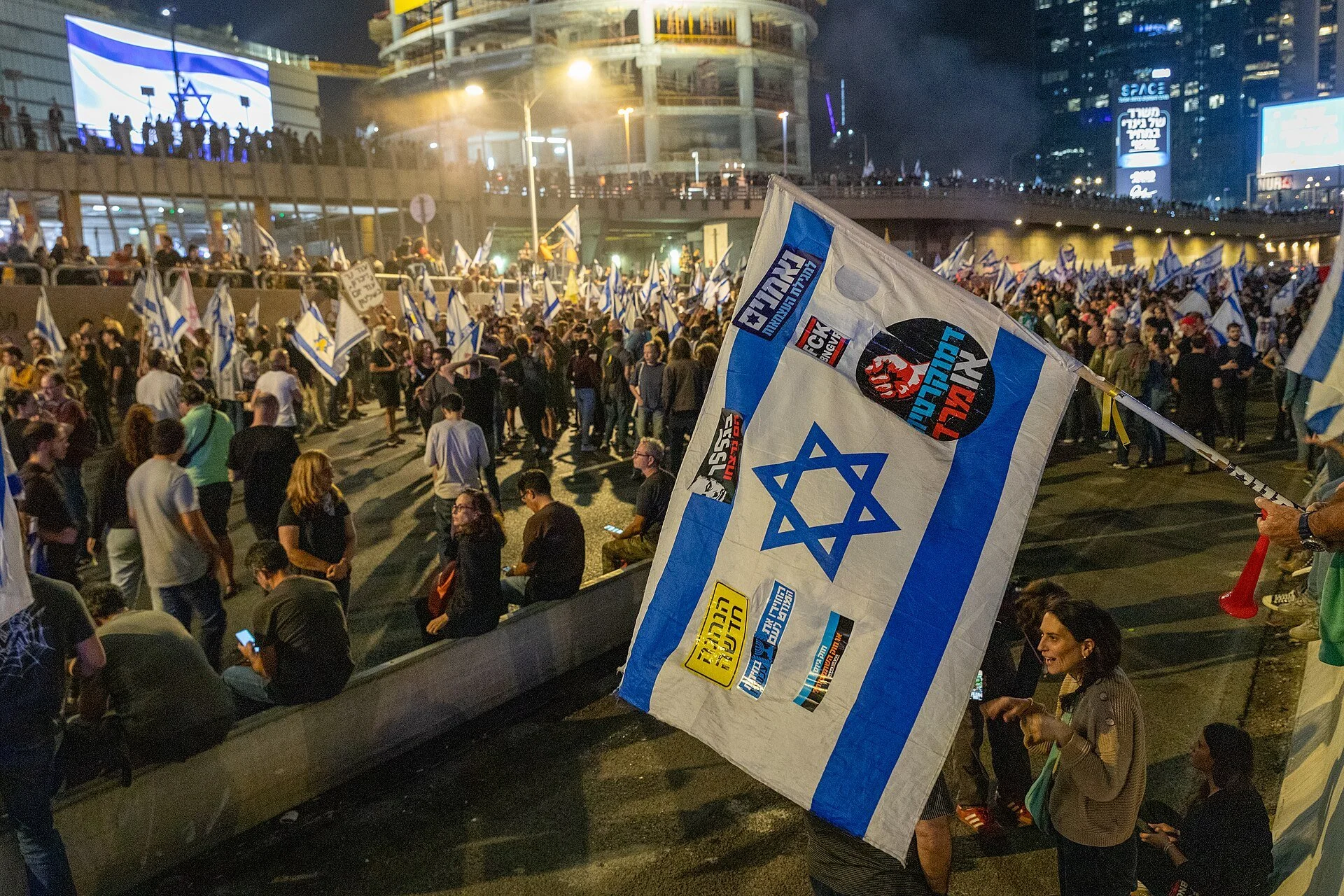
A 2024 protest against Yoav Gallant's dismissal by Netanyahu, featuring an Israeli flag with stickers that read: 'Democracy or Revolution,' 'New Leadership,' and 'Because of you, they were murdered' (referring to Netanyahu).
Dina Kraft — April 27, 2026
Views and positions expressed here are those of the writer, and do not necessarily represent NJN's views and policy positions.
For more than two years, the families of hostages were emblems of Israel’s collective anguish after October 7. Scenes on Thursday of the families screaming at each other outside the Supreme Court — and almost coming to blows — are a symbol of the deep divisions that continue to rive Israeli society. Pro-government bereaved parents shouted at and cursed fellow bereaved parents who, like them, lost sons and daughters during the October 7 attacks but, unlike them, are seeking government accountability for the deadliest catastrophe in the country’s history.
In one case, the verbal violence almost escalated to physical blows when one father started pushing another father.
“How can you (the pro-government families) yell at us and not let us say what we have to say? What has this country come to?” Ruby Chen said on Channel 13. His son Itai was killed the morning of October 7 while defending Kibbutz Nahal Oz. Chen is among those bereaved families who filed a petition asking the Supreme Court to order the government to establish a state commission of inquiry – something the government has refused to do.
“It’s horrific we have reached this point,” his wife Hagit added. “You could see the hatred in their eyes, but they are also people who, like us, are bereaved. I don’t understand why we have to be in such an ugly confrontation.”
One of the pro-government bereaved family members shouting her down Thursday kept repeating, “The Supreme Court is responsible for October 7.” Others held signs calling the court a “dictatorship.”
The pro-government bereaved family members are members of a government-aligned group called the Tikva Forum, which blames the Supreme Court for the 1,200 deaths and mass hostage-taking on October 7. It’s a “gotcha” theory that has been promulgated by some right-wing influencers and media figures who argue that the “activist” court, through past rulings, restrained the army from taking needed preemptive and defensive actions.
Prime Minister Benjamin Netanyahu has said that he favors a politically appointed panel to investigate October 7 over a state commission, which would be appointed by the president of the Supreme Court. Critics say this is part of Netanyahu and his government’s broader campaign to delegitimize and weaken the courts in a bid to secure more power for the executive branch – and in this case, elude any personal responsibility for the failures that led to October 7.
In the court hearings this month, the government has also argued that an investigation of any kind should wait until after all of Israel’s wars and wars within wars have met with “victory on all fronts,” claiming that such a high-level investigation while the wars are ongoing would harm the military in its work.
It turns out the melee between the family groups outside the Supreme Court building was only a prelude for what was about to follow inside: a small, but loud group of the pro-government bereaved families and their supporters moving like a wave towards the double glass doors leading to the Supreme Court chamber where justices were holding a hearing on the government’s refusal to establish a state commission.
Chanting “Try the Judges” (and according to some accounts also saying, “Slaughter the Judges”) and “Shame on you,” they tried to force their way into the courtroom.
Inside the courtroom, judges were alerted by security that they would have to leave the room. “What happened?” one of the justices can be heard saying as she hurriedly flees her chair.
One of the lawyers petitioning for a state commission of inquiry compared the attempt to forcefully enter the closed courtroom to the January 6 riots at the Capitol building in Washington in 2021.
Joshua Leifer, a Haaretz columnist, placed Thursday’s chaos in the context of the Israeli right’s longtime attacks on the judiciary. He wrote that the campaign is creating an “increasingly combustible atmosphere in which threats of violence and literal violent acts against the country's judiciary are championed and carried out by members of the Israeli government, and the court and its justices are accused of betraying the nation. It will, sadly, be of little surprise if the rage roiling the right's hardline base culminates in an even greater paroxysm of disorder or, worse, an assassination.”
At the hearing Thursday, two of the justices suggested that instead of forcing the government’s hand to establish a state commission of inquiry, given the upcoming election this fall, it would be best to leave it to the next government to do so. But some legal analysts called this a dangerous and misguided idea that would reward the two-year foot-dragging of the government and not those legitimately seeking such a commission. Israel, throughout its history, has used state commissions of inquiry to investigate significant national traumas and failures of the military, including the Yom Kippur War and the assassination of Yitzhak Rabin.
“The simple truth is that the justices are afraid. They see the organized displays of rage that certain actors make sure to orchestrate in the High Court halls,” wrote Yuval Yoaz, legal analyst for Zman Yisrael, referring to the evacuation of the judges.
“The rising temperature in the Supreme Court, signs of which have appeared repeatedly over the past year as the toxic legacy of the government’s 2023 judicial overhaul campaign evolved into actual physical intimidation, is not a natural phenomenon; it is man-made. Certain elements are making sure that this is the atmosphere surrounding the justices,” he added.
The majority of Israelis, 55 percent, support the formation of an independent state commission. But support has dropped off significantly in the last year among right-wing Israelis, while holding strong among left-wing and center Israelis, among which support is almost unanimous.
On Saturday night at the pro-democracy protests in Tel Aviv, the focus was strengthening the judicial system in light of the Supreme Court hearings on a state commission.
One sign being hoisted in the night sky read: “If October 7 doesn’t mandate a state commission of inquiry - what does?”
Dina Kraft is a journalist, podcaster and the co-author of the New York Times bestseller, My Friend Anne Frank, together with Hannah Pick-Goslar. She is a creator of the podcast Groundwork, about activists working in Israel and Palestine, and was formerly the opinion editor of Haaretz English.
Photo by Oren Rozen, CC BY 4.0, via Wikimedia Commons
