
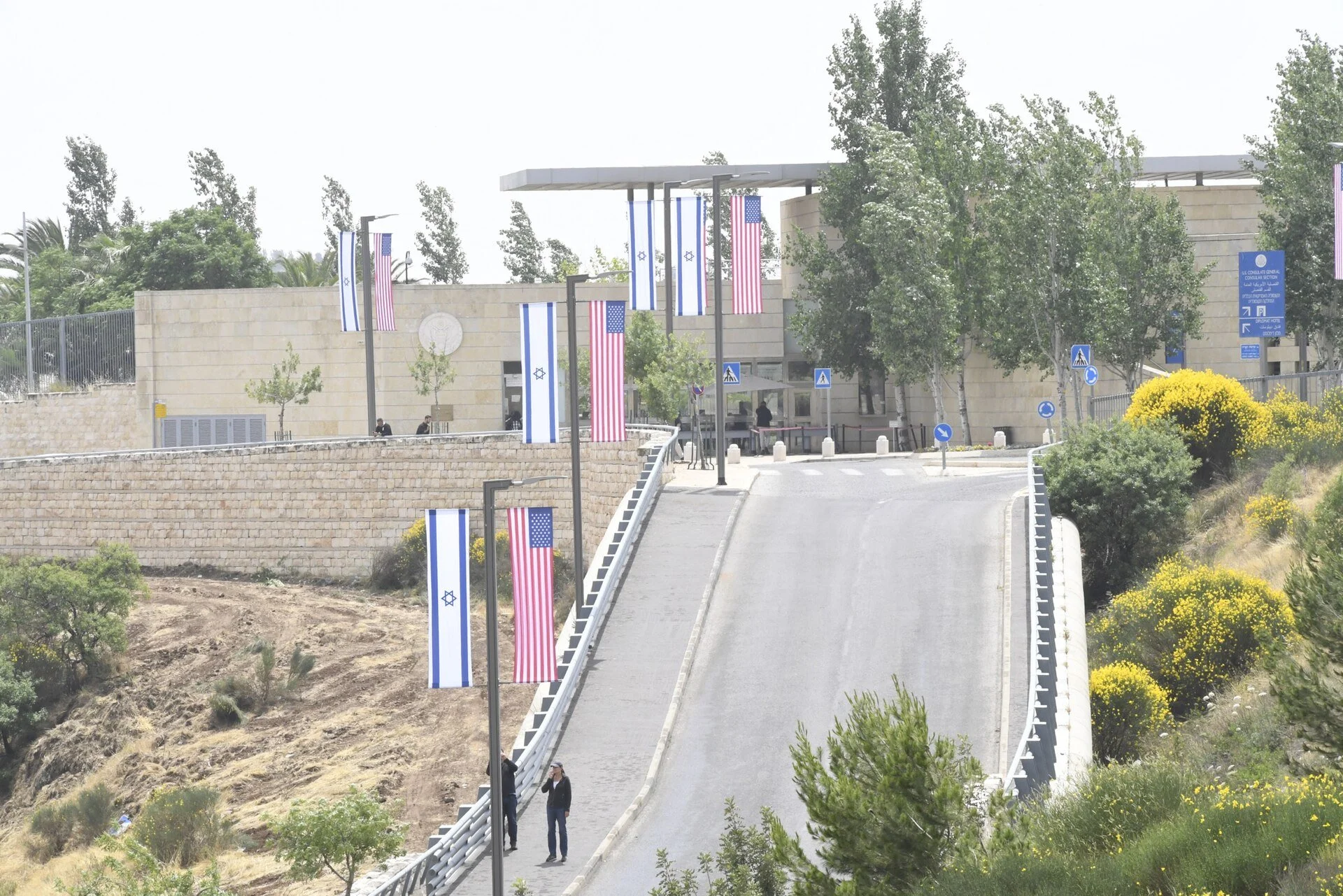
Photo by U.S. Embassy Jerusalem, CC BY 2.0, commons.wikimedia.org/wiki/Special:Redirect/page/69113913
Yossi Alpher — November 16, 2026
Views and positions expressed here are those of the writer, and do not necessarily represent NJN's views and policy positions.
Q. Strategic triangle? What is it? Why is it so important?
A. The United States and its Jewish community are the only true security allies Israel has. Back in the 1950s and ‘60s, Israel partnered militarily, briefly, with first Russia, then the UK and France. Since 1967, the partner has been the US. And since 1947-1948, the American Jewish community.
The US and its Jewish community, together with Israel, have for decades constituted, in my view, a kind of ‘strategic triangle.’ It is a foundation stone of Israeli strategic thinking.
War with Iran has fostered a new dimension in Israel’s strategic partnering, with the US and on occasion the UK and France joining Israel in military missions. Here we must recall that Islamist Iran is the only country that openly calls for Israel’s destruction and actively seeks to undermine it.
Can Israel manage in a stormy Middle East without strategic partnerships? With Russia and China increasingly aiding Iran, with Iran driving to develop a nuclear deterrent, and given the distance from Israel to Iran, Israel does not seem capable of going it alone. It needs American weaponry and financial aid. And it needs the political and moral support of American Jews. In the long term, these are existential needs.
And in today’s reality, they are endangered.
Q. What exactly is broken in the US-Israel-US Jewry strategic triangle?
A. Against the backdrop of the war with Israel’s Islamist neighbors that began in earnest on October 7, 2023, public opinion almost everywhere has turned against Israel: world public opinion, American public opinion and, in the US, increasingly, Jewish public opinion. What are perceived as gross Israeli human rights violations, particularly in Gaza and the West Bank, have blackened Israel’s name. The leadership under a Likud-led government is seen in many global quarters as genocidal or, at the very least, guilty of flagrant war crimes. Antisemitism is again on the rise.
The Trump administration, ostensibly a bastion of support for Israel, has its own problems and is taking its distance militarily and diplomatically. Beyond some ultra-Orthodox and Orthodox American Jewish circles, the American Jewish community is, to say the least, increasingly critical.
Netanyahu government talk to the effect that, thanks to Trump, Israel at least has a two-year window—until the 2028 US elections—to repair things rings increasingly hollow. Counting on Trump is obviously a doubtful proposition, if only because he is so strategically shallow and inconsistent. And it appears that in view of declining US public support, the ugly state of affairs in Gaza and the West Bank, and the drift of Israeli politics to the religious right, any conceivable Israeli government faces a grim reality in its dealings with the United States and its Jewish community.
In fact, the outgoing Netanyahu government seems to have done almost everything possible to weaken the triangle.
Q. Let’s take the best conceivable incoming Israeli government, led by Gadi Eizenkot. It will be based largely on moderate right and religious parties. Let’s even allow for an Israeli Arab participant. Let’s assume Eizenkot persuades all his partners that fixing the strategic triangle with the US and American Jewry is a top priority where he must have a free hand. What should he do?
A. Eizenkot must begin by replacing numerous Netanyahu-era diplomatic and informal emissaries who represent disgraceful policies like those we witness in the West Bank. In parallel and of primary importance, he must establish a national commission of inquiry to address the Gaza War issues head-on, with publicly aired investigative sessions and conclusions. From the standpoint of the Israeli public, the inquiry must ask: why the October 7 strategic surprise, where the security community and the government failed, and where IDF tactics and behavior must be faulted, and righted.
But this inquiry must also be for the world. Were there IDF atrocities? Where, if at all, did Israel behave immorally? Were acts of revenge at all justified? What can or should Israel do to right mistakes? What is at fault in Israel’s, its Arab neighbors’, and the international community’s concepts regarding the management of the highly problematic Gaza Strip?
Here Eizenkot—or more properly the High Court head who appoints the commission at his behest—should consider empaneling, alongside the Israelis on the commission, a distinguished representative of the international community. A jurist? A senior American Jewish leader? The idea is to enhance the moral standing of the commission’s findings and recommendations in the eyes of the world … Food for thought.
Q. What about the genocide allegation? One of Israel’s accusers, Navi Pillay, just got the Nobel Prize.
A. I personally, like most Israelis, reject the allegation. Yet it is undeniably out there in the global public domain, seriously threatening Israel’s international standing. Eizenkot’s commission of inquiry must not ignore it. Rather, it must (and this is definitely possible) confront it and dismantle it, concept by mistaken concept. In parallel, it must detail and analyze the allegations of war crimes, most of which have their roots in the kind of house-to-house guerrilla warfare that Hamas compelled Israel to fight, but some of which can and must be traced to racist and bigoted Israeli politicians, armed fighters and unhinged vengeance-seekers.
Q. Isn’t this kind of inquiry liable to both alienate the Israeli public and be perceived by Israel’s enemies as lowering its guard against genuine threats?
A. Under this admittedly best-case scenario, this will be the ultimate test of Eizenkot’s leadership: handling the fallout from a serious attempt at national stocktaking and strategic reform, carried out among a largely right-religious public and vis-à-vis Iran and a suspicious Arab world.
Q. Bottom line?
A. If the next Israeli government is going to begin to repair the damage to Israel’s global image, it must start by abandoning the ‘hasbara’ concept best embodied in the personage of Bibi Netanyahu: the notion that Israel’s policies are not at fault, but rather merely the way they are explained. Rather, when it comes to the Palestinian issue, the role in the country of its Arab minority, and the role of messianic religious elements, fundamental policies have to change.
I question to what extent this will happen under even an ideal Eizenkot government with its right-religious emphasis that, sadly, reflects Israel’s demography. But at least the issues should be clear. And if an Eizenkot government does not at least try, it will be missing a critical opportunity.
Meanwhile, it almost goes without saying that Eizenkot will have his hands full repairing the damage done by Netanyahu to Israeli domestic governance: judicial, economic, the education system, Jewish pluralism, and the police and rule of law.
This by itself is an awesome agenda.
Yossi Alpher is an independent security analyst. He is the former director of the Jaffee Center for Strategic Studies at Tel Aviv University, a former senior official with the Mossad, and a former IDF intelligence officer.
