
Bibi’s Emergency Trip to Washington
Yossi Alpher — February 9, 2026
Views and positions expressed here are those of the writer, and do not necessarily represent NJN's views and policy positions.
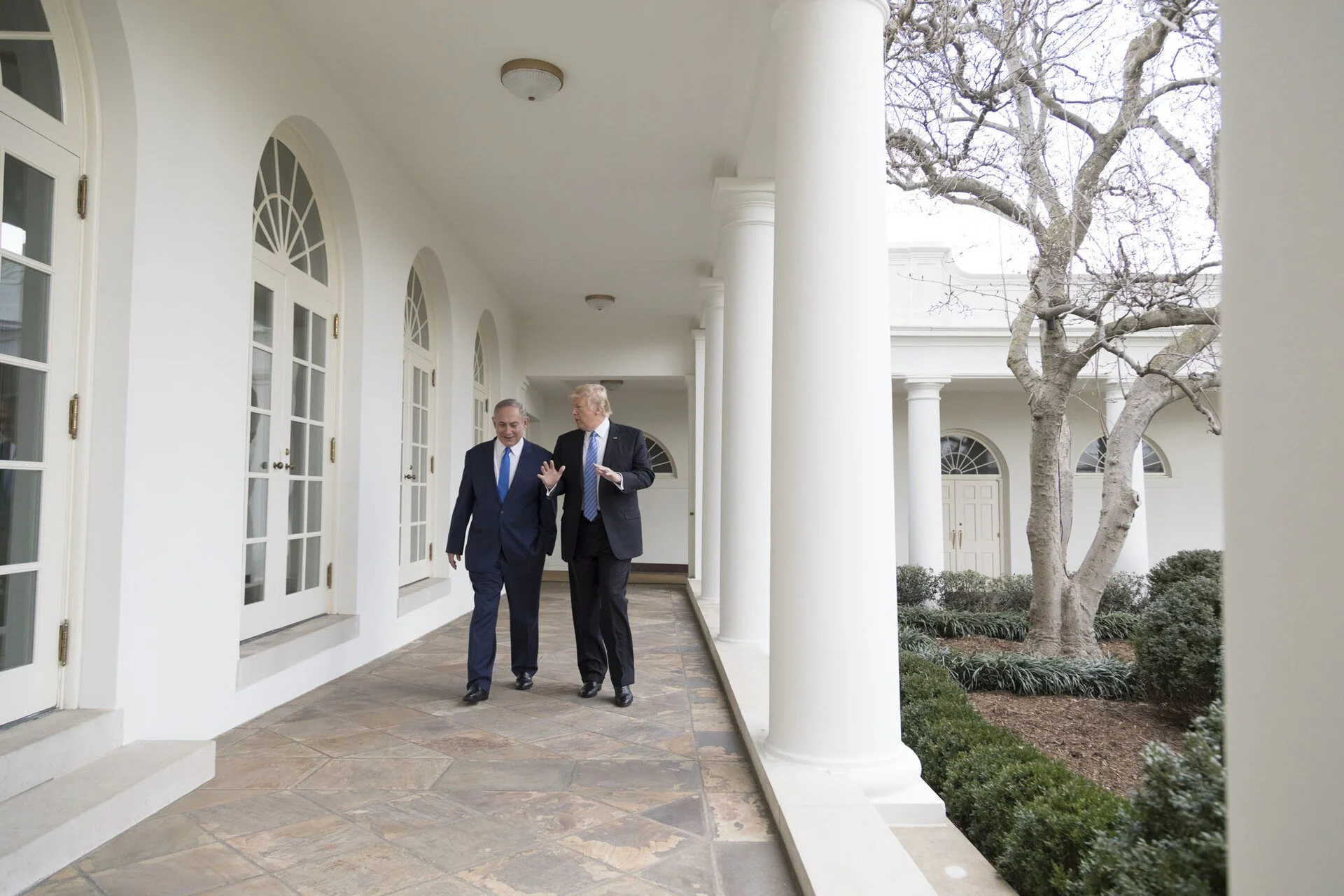
Q. All it took was an opening eight-hour round of indirect US-Iran talks in Muscat, Oman, to prompt Prime Minister Netanyahu to announce an emergency trip to meet President Trump this week. Why? What dynamic is at work here?
A. There are a number of possible explanations, all equally intriguing. Taken together, they describe the very complex triangle of US-Israel-Iran interaction and the highly questionable quality of leadership in Washington, Jerusalem, and Tehran.
Best to start with the official explanation from the Israeli Prime Minister’s Office: "The prime minister believes that all negotiations must include limiting ballistic missiles and ending support for the Iranian axis."
This presumably reflects Israel’s understanding that Washington and Tehran agreed in Muscat last weekend to discuss only the Iranian nuclear project and not a demand to limit or dismantle Iran’s missile project and to constrain Tehran’s support for anti-Israel proxies like Lebanese Hezbollah and Yemen’s Houthis. Netanyahu, according to this explanation, will protest to Trump and insist that Messrs. Witkoff and Kushner reverse their position and demand that negotiations comprise these issues too.
The logic of such an Israeli position reflects not only the serious damage inflicted over the last three years by Hezbollah on Israel’s north but particularly that wrought last June by Iran’s missiles during the “12-Day War.” Here, Prime Minister Netanyahu is understood to represent faithfully both Israeli public opinion and Israel’s strategic needs. Many residents of northern Israel are still afraid to return home. Iranian missiles scored frightening hits, all very visible, on the Weizmann Institute, Soroka Hospital, and IDF bases.
Q. In other words, Netanyahu has “unfinished business” with Iran – a perception not necessarily shared by the Trump administration…
A. Indeed, it would be a problematic argument for Netanyahu to make in Washington, given that Israel’s unfinished business from the war that began on October 7, 2023 comprises not just Iran, Hezbollah, and the Houthis but Hamas in Gaza as well. Trump can claim that he is investing a lot of American capital and prestige in bringing to a conclusion a Gaza conflict that the IDF has proven incapable of winning decisively.
Q. But surely there is an alternative explanation for Netanyahu’s hasty trip, one derived from the same set of facts about the first round of Muscat talks.
A. Yes. According to this alternative “take” on Muscat, precisely because Kushner and Witkoff returned to Washington convinced that the Tehran regime is not prepared to discuss Iran’s missiles and its proxies, the US must attack Iran to further “soften it up” for concessions. Accordingly, Netanyahu and Trump are in a hurry to discuss the fine points of a US military attack on Iran. The Israeli aspect concerns some sort of US role in defending Israel against those missiles and/or an IDF role in another round with Iran.
One variation on this theme places Netanyahu, alone, in the role of pushing a reluctant Trump to attack Iran again, now. Here, it is helpful to recall Netanyahu addressing the US Congress in 2002 to advocate a US offensive to conquer Iraq. That initiative, which Prime Minister Sharon and other Israeli strategic figures opposed, ended disastrously.
Interestingly, Netanyahu is bringing with him to Washington Brigadier General Omer Tishler, who is slated soon to command the Israel Air Force. Tishler is one officer who logically would coordinate Iran attack plans with the Americans.
Note, in this context, that the US military buildup in the Persian Gulf theater continues apace–a dynamic meant to be driven home to the Iranians by the Witkoff-Kushner photo-op visit to a US aircraft carrier in the region. But note, too, that the Gulf Arab countries that fear the overflow of a new US-Iran round of fighting appear to be unanimous in pressuring Trump to negotiate rather than to attack. Some reports indicate that it was precisely such Arab pressure that persuaded Trump last month to shelve attack plans.
Q. Does this bring us to an examination of the ultimate conceivable objective of military action against Iran, especially in the aftermath of last month’s violent unrest there: regime change?
A. If I were an Iranian opponent of the regime, having heard Trump’s empty boast that “help is on the way” followed by... nothing... I would not put much stock in talk by American (and the occasional Israeli) hawks about toppling the Islamic Republic regime. It is not that easy. The regime in Tehran remains solidly in power after, and despite, recent months’ bombings and mass demonstrations.
By the same token, the Tehran regime is liable to have little faith in any “deal” with Trump, considering that it was he who, in 2018, unilaterally pulled out of the previous nuclear deal, the JCPOA.
The Iranian “opposition,” such as it is, has no viable leader and no viable alternative ideology for ruling Iran. Besides, a prospective US-Iran nuclear deal would reinforce the international legitimacy of Tehran’s bloodstained Islamist regime in the eyes of both the Iranian and the American publics.
Q. Is Gaza likely to be on the Trump-Netanyahu agenda in the hasty White House meeting this Wednesday?
A. By coming to Washington now, Netanyahu apparently avoids an awkward first meeting of Trump’s Board of Peace next week. There, Bibi would have to contend with the leaders of Turkey and Qatar, who are close supporters of Hamas and whose involvement in the Gaza process Israel objects to. The very fact that Trump has embraced the two countries as peace partners in Gaza merely reinforces the reality of serious gaps between the US and the Israeli perceptions regarding two critical Middle East issues: a deal with Iran and the coming steps in Gaza.
Q. Bottom line?
A. Finally, there is the question of negotiating style or at least the style attributed to each side. Iran’s Foreign Minister Araghchi reputedly is skilled at drawing out and diffusing talks; Trump’s team of Kushner and Witkoff make real estate deals based on quick trade-offs for mutual benefit, regardless of considerations of religion and ideology. Are these styles compatible? Contradictory?
Meanwhile, on the sidelines, the Saudis, UAE, and other Gulf states – Iran’s neighbors and trading partners – are counseling patience and compromise, while Israel, with its understanding of Islamist Iran’s existential threat against it, rejects compromise. Lest we forget – Iran and its Islamist proxies Hezbollah, Hamas, and the Houthis – are the sole remaining Middle East actors that openly preach Israel’s destruction. And Iran has nuclear aspirations.
On the sidelines, two thoughts on the strategic backdrop. First, in view of all the renewed war talk, whatever happened to last June’s Israeli and American declarations assuring us that Iran’s nuclear and missile capabilities had suffered heavy losses? That was barely half a year ago.
And second, this very short trip will barely give Netanyahu time to “chill” from heavy political pressures back home: October 7 accountability, skyrocketing Israel-Arab sector violence, Haredi draft evasion. And, heaviest of all, elections that are mandated by October.
Yossi Alpher is an independent security analyst. He is the former director of the Jaffee Center for Strategic Studies at Tel Aviv University, a former senior official with the Mossad, and a former IDF intelligence officer.
