
Revolution in Iran, then and now
Yossi Alpher — January 12, 2026
Views and positions expressed here are those of the writer, and do not necessarily represent NJN's views and policy positions.
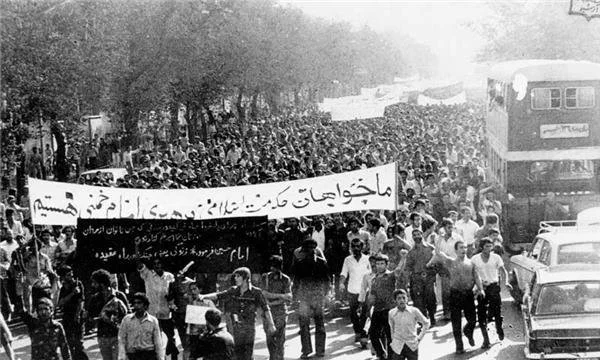
Q. You were Israel’s chief intelligence analyst for Iran nearly 50 years ago when Ayatollah Khomeini toppled the Shah’s regime. Déjà vu?
A. The comparisons and contrasts are both constructive and challenging. Certainly it seems fair to say that, like in 1978-79, Iran is once again in a ‘revolutionary situation.’ That means great uncertainty and a cast of actors whose decisions and actions cannot easily be anticipated by outside observers. Indeed, even the primary actors, from Supreme Leader Khamenei on down, probably do not know for certain what their next move will be.
Under these circumstances, the best an intelligence analyst can do is try to accurately understand and describe what is happening, but not to predict what may or may not happen next. That is my admonition to today’s pundits and experts.
Q. Back in the late 1970s, Iran was friendly to Israel and the West. Did you and colleagues in Washington and London have good intelligence on the Shah’s regime and the revolutionary opposition?
A. No, and that fact stands in sharp contrast to today’s reality, wherein Iran is an enemy that everyone wants to spy on. As the Khomeini revolution progressed in 1978-1979, I recall becoming increasingly aware that the ‘experts’ on Iran--both Iranians on the scene and those in Israel, Europe, and America (including many Israelis who had spent years in Iran)--knew virtually nothing about the Islamist opposition. Accordingly they did not understand the revolutionary dynamic that was unfolding in the mosques and on the streets.
Back then, you did not spy on friends like the Shah of Iran, especially when the Shah threatened point blank to cut all ties if he found you snooping or even spying on those who openly opposed him.
My own experience here was traumatic. In early January 1979 the Shah fled Iran. The caretaker prime minister he left behind, Shapour Bakhtiar from the secular opposition, summoned the Mossad representative in Tehran and made a single request of Israel (a request that, much later, I discovered he had also made to the CIA, British MI6, and French SDECE): “Kill Khomeini.” When Mossad Head Yitzhak Hofi asked my opinion of Bakhtiar’s request I felt obliged to reply, after a pregnant moment’s consideration, “We don’t know enough about Khomeini for me to make a judgment in view of the risks involved.”
Within mere days, Khomeini took over and began a reign of terror, violence, and evil that has never ended.
Do Israel and others have the necessary intelligence about Iran today to make sound decisions? Certainly our knowledge of Iran’s inner workings is far better today than in 1979. But Israel’s colossal intelligence failure of Oct. 7, 2023 regarding Hamas and Gaza gives me pause for concern. As for the Trump administration’s intelligence, the less said...
Q. Currently the catalyst for revolt and unrest appears to be primarily economic...
A. Iranians have really been placed in a desperate economic bind by inflation and devaluation. Strikingly, even President Pezeshkian at one point seems to have thrown up his hands in futility. Back in 1979, in contrast, protest was primarily ideological and Islamist, not economic. Ostensibly, this makes a difference regarding regime capacity to conciliate the masses.
In 1979, the Shah could not compromise with the mosque-based Shi’ite clerical establishment: the clash was existential. Today, that same clerical establishment, now the rulers, can at least look for ways to improve the economic situation and thereby, possibly, ‘buy off’ the street.
Further, this regime has quite obviously made extensive preparations for the day when it will confront an attempt to dislodge it the way it dislodged the Shah in 1979. It successfully put down widespread unrest in 2009, 2017-18-19-22, and ’23. It has the triple-layered defense of the army, the Basij, and the Revolutionary Guards, the latter two not yet fully deployed. Thus far, there have been no serious defections from these bodies.
Q. Over the past year, the regime has witnessed the weakening of its proxies in Lebanon, Syria, and Yemen. Is this a factor influencing public unrest?
A. I do not think the public is attacking the regime over the ‘loss’ of Syria. This same public never supported the diversion of resources to these proxies. On the other hand, some observers argue that Israel militarily humiliated the regime last June during the Twelve-Day War, thereby hurting public support.
Q. There is no identifiable leader of this revolution other than the Shah’s exile son, Reza Shah, based in Washington. But he has no known ‘divisions’ (recall Stalin: “The Pope: how many divisions does he have?”) and no clear degree of Iranian popular support.
A. Back in 1979 it was only after the revolution that we were able to identify a Leninist-style Islamist revolutionary leadership, command structure, communications network and mosque-based ‘cells.’ There is no indication of anything similar today. But Iran has a long revolutionary tradition and we cannot rule it out. The regime’s blackout on communications--internet, telephones, etc.--has rendered it all the more difficult for both Iranians and outsiders to divine what exactly is happening.
Q. Presumably Iran’s neighbors are watching with great interest...
A. Yes, and herein lies yet another parallel dynamic that recalls events well before 1979. Iran is an empire in which ethnic Shiite Persians are a majority yet multiple minorities (many Sunni Muslims) remain, with a long history of pulling away when the central regime is weakened. Kurds in the northwest, Baluch in the southeast, Arabs in the southwest, and restive Turkmen (and others) elsewhere--all look to potentially sympathetic neighbors across the border.
How will Turkey, Azerbaijan, Pakistan, and Gulf Arabs react if Iran shows signs of weakness at the center? Undoubtedly Russia, too, a slightly more distant neighbor, is watching closely--as it has every Iranian/Persian revolution.
Q. Was it Napoleon who said “Never attack a revolution?”
A. Something like that. The relevant example here is Saddam Hussein of Iraq, who attacked revolutionary Iran in 1980, ultimately with mixed results that fell far short of the Arab goal (Saddam had a coalition of Arab-state backers) of bringing down an Iranian Shiite revolution that threatened the Sunni Arab world.
Q. Does Napoleon’s admonition apply to US President Trump? He is threatening to attack the Tehran regime if it kills an (unspecified) number of Iranian civilians.
A. It should apply. Since Venezuela, Trump’s threats are taken more seriously. But it is a dangerous gamble to assume that Iran’s civilian anti-regime population will applaud a US bombing campaign that targets regime symbols and institutions but inevitably causes civilian casualties too, yet does not topple the regime itself. It could cause Iranians to rally round the regime.
On the other hand, the regime might be hard put to counter simultaneous aggression on two fronts: the US and the Iranian public. The regime could respond with a ‘nothing to lose’ approach of extreme violence toward any and all demonstrators.
Then too, note the reports that the regime is seeking to renew nuclear negotiations with the US, possibly with Omani mediation. If Trump is wielding both a stick and a carrot in Tehran’s direction, this might conceivably help stabilize the situation.
Finally, no matter how we ‘count’ the demonstrators in the streets of Tehran and Isfahan, let’s not forget that there are still plenty of Iranians who support the Islamist regime.
Q. Can you share some scenarios for what conceivably could now happen in Iran?
A. Speculatively and tentatively!!! Unrest, clashes and casualties could continue for weeks or months and eventually peter out, with the regime still in place, however battered. One variation could be a move by the Revolutionary Guards to promote an alternative leader to Khamenei, who would be effectively ‘kicked upstairs’ in the hope that ‘change’ and subsequent ‘reform’ would satisfy demonstrators.
If, for argument’s sake, the regime falls, flees, or otherwise collapses, we would see whether the opposition has an alternative leader and alternative armed force, or whether anarchy reigns. Certainly the exiled Reza Shah is a doubtful candidate to land dramatically, sweep the masses Napoleon-style, and rule happily ever after.
And if anarchy does reign, Iran with its geostrategic centrality could become the focus of unrest radiating throughout the Middle East.
Q. Finally, Israel?
A. Prime Minister Netanyahu is keeping a relatively unaggressive profile, though there are constant (unsubstantiated) intimations that the Tehran regime will attack Israel, ostensibly to distract the Iranian public.
At the end of the day, Israel is not, nor should it be, a player here. Note that during the Twelve-Day War last June, Netanyahu and others hinted that Israel’s attack could weaken or even topple the Iranian regime. Nothing of the sort happened. It would be nice to believe that Bibi learned something from that experience.
Yossi Alpher is an independent security analyst. He is the former director of the Jaffee Center for Strategic Studies at Tel Aviv University, a former senior official with the Mossad, and a former IDF intelligence officer.
