
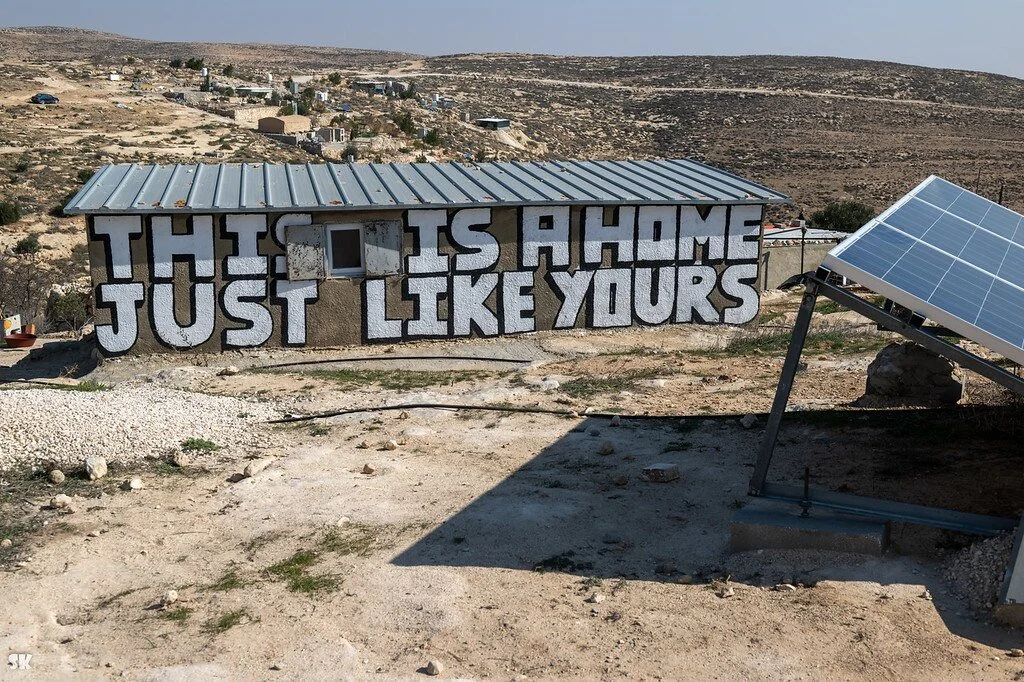
A house in Masafer Yatta at risk of eviction.
Noam Shelef — March 9, 2026
Views and positions expressed here are those of the writer, and do not necessarily represent NJN's views and policy positions.
The news right now is a lot. The imagery of burning oil facilities near Tehran reminds me of the Kuwaiti oil wells set ablaze by Saddam Hussein’s forces during the Gulf War. Iran is now reportedly using cluster munitions in the warheads of missiles heading toward Israel. And as I put the final touches on this piece, I see video of a missile fragment hitting Or Yehuda, a city adjoining Ben Gurion Airport. Media reports say there are fatalities in central Israel.
I’ve only scratched the surface. It’s easy to be overwhelmed by the torrent of news – much of it taking place 1,000 miles from Israel. But as the world watches the skies over Iran, something else is happening on the ground much closer to home: the situation in the West Bank and Gaza is deteriorating under the cover of war.
This is not entirely surprising. For decades, the settler movement in Israel has organized itself around the principle of “never let a good crisis go to waste,” exploiting Palestinian terror attacks or domestic Israeli political upheaval to create literal “facts on the ground.” During the two years of intense fighting since October 7, we have seen the Israeli government – composed largely of political leaders groomed by the settler movement – make major changes in the West Bank. (We explored some of these developments in an NJN webinar I hosted with Peace Now’s Hagit Ofran.)
Why wouldn’t this same movement take advantage of the moment provided by the war with Iran to strike at its perceived enemies, create circumstances to derail the Gaza ceasefire, and prevent the possibility of a Palestinian state?
Here are three developments from the past week that I am watching closely:
Gaza Closure
On February 28, Israeli authorities closed all crossings to Gaza “until further notice.” The announcement of this closure included the infuriating claim that shutting off access to Gaza would have “no impact on the humanitarian situation” because the food that has entered Gaza since the ceasefire began “amounts to four times the nutritional needs of the population.”
There is much that is exasperating about this argument. At the most basic level, it implies that addressing a humanitarian crisis means little more than meeting a bare minimum calorie count.
The closure was eased three days later when the Kerem Shalom crossing partially reopened. The other crossings remain closed as of this writing.
It bears mention that the re-opening of Kerem Shalom reportedly took place following a call made by Steve Witkoff’s senior advisor to Prime Minister Benjamin Netanyahu. American pressure can impact Israeli policies.
If you want to follow this issue more closely, consider following Gisha, an Israeli NGO whose work I’ve long admired.
Old-School Settlement Construction (But Much Faster)
Peace Now reported this morning that the new war is not slowing the dramatic expansion of settlements in the West Bank. The latest example: on Wednesday, an Israeli government planning body will vote to give final approval to the construction of126 housing units in the settlement of Sha’arei Tikvah.
This vote continues an extraordinarily rapid pace of approvals. 2025 was a record year, with the same planning body advancing roughly 28,000 housing units.
In the past, these approvals could only proceed after the Israeli defense minister signed off. In the summer of 2023, the Israeli government eliminated that requirement – removing a key political checkpoint and accelerating the process.
Violence from Settlers (and the IDF)
When I worked at Americans for Peace Now in the 2000s, we warned about violence by settlers against Palestinians and IDF targets. At the time, these incidents were known as “Price Tag” attacks, in which the most radical settlers would exact a “price” in violence to deter Israeli government policies they opposed.
Right-wing Israeli leaders at the time downplayed these attacks, describing the perpetrators as mere “errant weeds.”
The violence we are seeing today is far more brutal – and far more sinister. It also benefits more directly from government support and, increasingly, from the involvement of the IDF. Allegations of IDF complicity are behind Peace Now’s effort to press the army to remove General Avi Blut, who commands IDF forces in the West Bank.
These attacks have reportedly resulted in five Palestinian deaths since the weekend:
In the village of Abu Falah, 24-year-old Thaer Hamayel and 57-year-old Fare’e Hamayel were shot dead. Fifty-five-year-old Muhammad Marah suffocated after exposure to tear gas fired by Border Police forces who arrived at the scene.
In Masafer Yatta, 27-year-old Amir Senaran was killed after settlers entered his village. His older brother was seriously wounded in the shooting, and at least three others were hospitalized after severe beatings.
Today, Muhammad (52) and Fahim (47) Muammar were shot dead in a village near Nablus. Three others were injured by gunfire.
Some reports indicate that the perpetrators were settlers; others say the violence came from IDF soldiers. This confusion is not accidental. The Israeli NGO Yesh Din released a report two weeks ago documenting how the settlers are blurring the lines between themselves and the IDF.
Over the past two years, settler violence – often backed by the presence or support of Israeli soldiers – has pushed Palestinians off their land. And it is no surprise that Yesh Din has documented that thesesettler rampages are increasing under the cover of the Iran war.
As this new pattern of violence has become clearer, I have been encouraged to see more Israelis traveling to villages most frequently targeted by settlers to provide what they call a “protective presence,” based on the assumption that settlers would hesitate to attack fellow Israelis.
Recent events – including somedisturbing video footage – shows that this assumption may not hold. Israelis engaged in this “protective presence” are not immune.
Stepping Back
The war with Iran is dominating the headlines, and understandably so. But we cannot let the war in the air obscure the battles on the ground. While the world watches the missiles, the map itself may be changing. And by the time the war everyone is watching ends, we will have to live with the consequences of the war no one is watching.
But the future is not written. NJN’s role right now is to speak out, contain the damage the settlers want to create, and make possible a better future. Thank you for being a part of it with me.
Noam Shelef is New Jewish Narrative’s Vice President of Communications. His career began nearly 30 years ago as an intern for Americans for Peace Now. Since then, Noam has worked to support progressive change in Israel as a lobbyist, an organizer, and a communications leader.
Photo by: שי קנדלר, CC BY-SA 4.0, via Wikimedia Commons
