
Why is Netanyahu afraid to call October 7 a “massacre?”
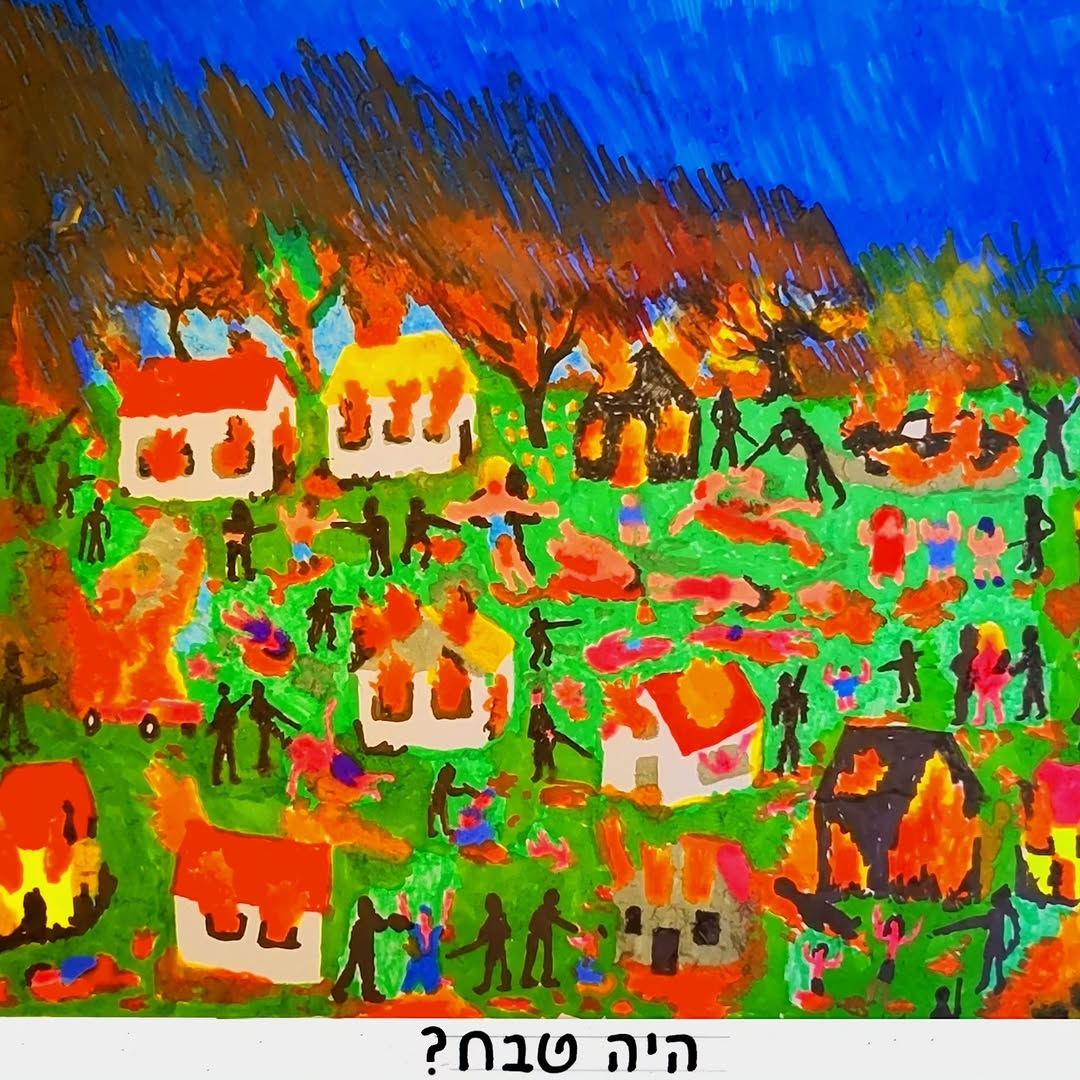
Image Credit: Zeev Engelmayer
The Hebrew title reads, ironically, "Was there a massacre?"
Dina Kraft — February 16, 2026
Views and positions expressed here are those of the writer, and do not necessarily represent NJN's views and policy positions.
This summer was the first time I heard in person someone refer to October 7 as an “event.” I almost thought I did not hear correctly at the time – an event? Really? It was at a talk on an entirely different subject, the comment made by an American professor in passing. I was so upset by the erasure of the day’s violent horror that I had trouble sleeping that night.
I flashed back to that same feeling of disbelief and insult last week, but this time I was even more shocked because it was the government of Israel using the same language of “event” to describe the bloodiest and most traumatic day in Israeli history.
“Event” was the word the office of Israeli Prime Minister Benjamin Netanyahu said should replace the word “massacre” in the title of a new law being drafted to establish an annual national memorial day for October 7, 2023.
Notably, this is the same government that has no problem using words like “massacre” or “atrocity” abroad. Netanyahu, in his two addresses to the UN General Assembly since the Hamas-led attack, described it as “a horrific massacre.”
His government worked hard to hold as many screenings as possible of the so-called “atrocity film” for politicians and journalists around the world, compiled by the army’s spokesperson's office from footage taken by body cameras worn by Hamas as they attacked and killed. The screenings took place at a time when Israel was trying to shore up support for the war being waged in Gaza amid a massive global public opinion backlash against it.
A government representative to the Knesset panel drafting the memorial day bill argued that “event” was the more appropriate word to use in its title since that day also saw soldiers defending Israel. A statement from the prime minister’s office defended the choice, saying the descriptor of “massacre” was used in the language of the bill itself. Indeed, there were units that fought, but such a deliberate reframing in the title downplays the fact that 1,200 men, women and children were killed, most of them civilians. Removing the word “massacre” seems to be intended to sidestep the immense trauma October 7 caused and the governmental and military failures of the day. Not only was it devastating for its scale and for the catastrophic intelligence and operational failures that allowed it to take place, but because so many were left undefended for so long.
Thousands of Israelis under attack waited hours for the army to show up as their loved ones and neighbors were shot, set ablaze in their own homes, and taken as hostages. In the case of Kibbutz Nir Oz, I was told it took about seven hours for army troops to arrive, long after the killing of 47 and hostage-taking of 76 was over.
Culture Minister Miki Zohar defended the wording in an interview on Israel Radio, saying, “We can definitely be vulnerable, but we are not being slaughtered… I’m less interested in playing the victim. We’re a powerful country.”
On Saturday night, thousands took to the streets with a different reaction, demanding a National Commission of Inquiry. Families of those killed on October 7 and other protesters argue Netanyahu has been evading his responsibility for October 7 since the day it happened and is now attempting to rewrite history.
Chen Zander, whose sister Noa was killed at the Nova party, said in an interview on Channel 13, “I wish there was an even more damning word for what happened on October 7. It’s not an event, it’s a massacre. And every attempt to minimize, reduce, or cover up what happened only deepens the responsibility of those who try to do so.”
Zander’s sentiment that calling October 7 an “event” represents an attempt to evade responsibility is not uncommon. But there is arguably something more at play.
In March 2024, in my role at the time as opinion editor for Haaretz English, I commissioned Ishay Rosen-Zvi, chair of the Department for Jewish Philosophy and Talmud at the University of Tel-Aviv, to help answer a question that had been weighing on me: why did it seem that so many national religious Israelis were passive in their response to the hostages being held there?
He wrote in his op-ed that what we were seeing was not a continuation of Jewish tradition, as Jewish history was full of examples of communities fighting for the return of their captives and their rescue is a central tenant of Judaism, but a new kind of nationalistic religiosity that places national pride over perceived weakness.
I think it’s worth revisiting his words now:
“Some in the far-right Religious Zionist Party have also cultivated a visceral antagonism towards the very idea of Jewish vulnerability. In this telling, Jewish Israelis should at all times project an image of power and dominance.
“This is not just a reincarnation of the old ‘Sabra’ image from early statehood, but an entirely new ideology… It is a melding of jingoistic tendencies that have always existed in Judaism together with novel nationalistic voices along with a vigorous dose of messianic expectations. This is not an authentic expression of Jewish tradition, but rather a new type of Judaism, one that glorifies power and scorns the weak and needy. It is a reversal of the Jewish tradition I have dedicated my life to learning and teaching.”
Netanyahu himself is not religious. But he has done more to elevate the far-right religious Zionist camp and ensure their position of power than any other Israeli prime minister.
Whether this new type of religious nationalism will be allowed to write the script in Israel is a question Israelis, and those who care about Israel, will needs to address. The fight over the word “massacre” in the name of the national memorial day for October 7 is one more urgent reminder of that.
Dina Kraft is a journalist, podcaster and the co-author of the New York Times bestseller, My Friend Anne Frank, together with Hannah Pick-Goslar. She is a creator of the podcast Groundwork, about activists working in Israel and Palestine, and was formerly the opinion editor of Haaretz English.
